

siRNA
Advancing a next-generation approach
Our partner, Arrowhead Pharmaceuticals, developed a proprietary RNAi technology called TRiM with the goal of overcoming the challenges of current RNA therapeutic approaches.
siRNA-mediated RNA interference: Specific Target Knockdown
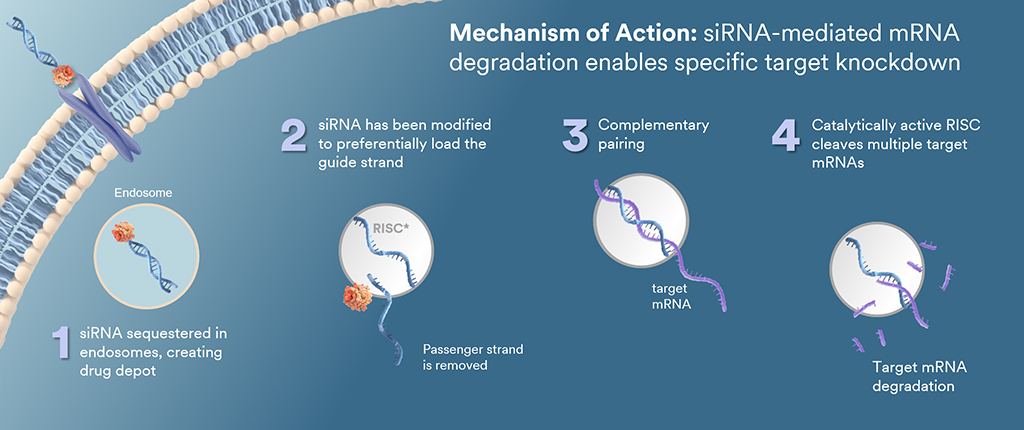
Below is a depiction of how TRiM proprietary technology works.
- The siRNA is taken up by tissue and into an endosome by a specific ligand.
- Modifications such as a stable phosphate on the guide strand have been made, aiming to create metabolic stability and efficient RISC loading.
- This next-generation approach aims to offer increased potency since a catalytically active RISC cleaves multiple targeted mRNAs.
The potential benefits of this technology include:
- Designing the chemistry to improve potency and specificity, thereby potentially mitigating off-target effects to achieve silencing of disease-causing mRNAs and proteins;
- By targeting mRNA directly these therapies have the potential to target any disease-causing protein, thereby increasing the number of potential drug targets; and
- Knocking down disease-causing mRNAs with the goal of reaching areas in the body that are difficult to penetrate.
Our lead programs leveraging this technology are being developed to treat facioscapulohumeral muscular dystrophy type 1 (FSHD1) and myotonic dystrophy type 1 (DM1) for which treatments do not currently exist.
SRP-1001 (formerly ARO-DUX4) to treat FSHD type 1
SRP-1001 (formerly known as ARO-DUX4 developed by Arrowhead Pharmaceuticals), currently in clinical development, is designed to reduce the production of human double homeobox 4 (DUX4) protein in skeletal muscle.
SRP-1003 (formerly ARO-DM1) to treat DM1
SRP-1003 (formerly known as ARO-DM1 developed by Arrowhead Pharmaceuticals), is in clinical development to treat myotonic dystrophy type 1, or DM1. DM1 presents as the most severe form of the disease and is driven by an expanded CUG trinucleotide repeat in the 3’-untranslated region of DMPK transcripts. These abnormal transcripts cause broad mis-regulated splicing which are directly linked to the clinical manifestations of DM1. To correct this mis-regulation, Sarepta is investigating an RNAi conjugate designed to target and suppress DMPK in skeletal muscle. The Company believes that silencing the aberrantly transcribed DMPK mRNA using SRP-1003 has the potential to halt CUG expansion-related splice defects in patients with DM1.