Every Duchenne journey is different. Here, people living with Duchenne and others connected to the community share their experiences in their own words. As the community reflects on the 10 years since the U.S. FDA approval of the first therapy specifically for Duchenne, they look back on a decade of evolving care and changing possibilities.
Whether you're interested in Darrel's journey as a content creator and storyteller, Aditya's experience learning to advocate for himself while building a career in aerospace technology or Kara's perspective from the front lines of Duchenne care, each story offers a different view of what the past decade has meant to people across the Duchenne community.
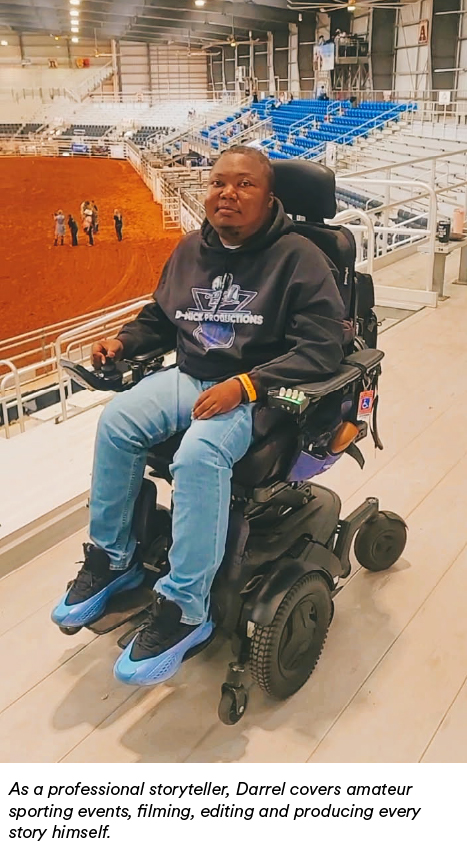
Darrel Nicklow, Jr.
28 years old
Living with Duchenne
Content Creator, Graphic Designer
“I was diagnosed with Duchenne when I was 5. I had a heart transplant when I was 13. And I’ve been receiving weekly infusions of exon-skipping therapy since 2017. Every Thursday, I have an infusion. It's just part of my life.
But I don’t talk about Duchenne very much. I don't want that to be the main thing about me. It would take away from who I am. I have a bachelor’s degree in Digital Media Design and a master’s degree in Educational Technology, with a minor in interdisciplinary studies. I started my own company and work as a graphic designer. I'm also a content creator and sports storyteller.
These days, I'm focused on being happy. I want to be healthy, I want to make people proud of me and I want to keep doing the things I love.
I've been a sports fan my entire life. In 2020, my mom gave me a camera and I started making videos. Now I travel to games, interview players and tell stories on my YouTube channel. I want people to see the atmosphere, the crowd, the personalities and what makes those athletes interesting. A lot of times, I'm telling stories about people and teams that don't get much recognition.
Every day I’m working. It fuels me. Most people would have a team helping them. I'm doing it all on my own.
These days, I'm focused on being happy. I want to be healthy, I want to make people proud of me and I want to keep doing the things I love.
It’s cool to think about that I was one of the early patients on exon-skipping therapy. It’s like I'm one of the founding fathers. Without this medicine, who knows if other medicines would have been developed. I helped create a chain reaction. Being part of that means a lot to me.”
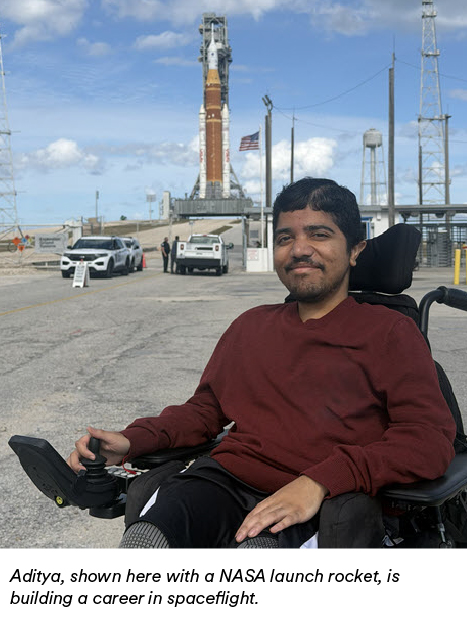
Aditya Nair
25 years old
Living with Duchenne
Inflight Software Developer
“I was diagnosed with Duchenne at 6. I’m 25 now, on an exon-skipping therapy and have been steady for a couple of years.
Back when I was in high school and thinking about a future career, I looked for something that matched my strengths and interests. I got into computer science, and the more I learned, the more I realized it was a good fit. When I’m coding, I get what I call a ‘coder’s high.’ I don’t want to stop until I get to the solution, and I can stay at it for hours.
I write code that helps a spacecraft dock with a space station in lunar orbit. It’s a huge honor to use my degree in a way that feels meaningful and to contribute to something that could have a real impact.
I earned my degree in computer science, got a job and moved into my own condo. I also started working toward a master’s degree in AI.
Independence is really important to me. When I was in college, I started going to doctor’s appointments by myself. When my parents were with me, people didn’t always speak directly to me. Going on my own gave me the chance to ask questions and speak for myself. That’s when I got into the habit of being my own advocate.
I think that’s becoming more important for people growing up with Duchenne. As new treatments and advances continue to change what’s possible, more people are thinking about college, careers and what comes next.
For me, the next frontier is space. I was always a space guy, and a huge Star Wars fan growing up. Now, I write code that helps a spacecraft dock with a space station in lunar orbit. The coolest part is playing my part, however small, in helping put American boots back on the Moon and knowing that the work my team is doing today could help pave the way for humans to go even farther in the future.
It’s a huge honor to use my degree in a way that feels meaningful and to contribute to something that could have a real impact.”
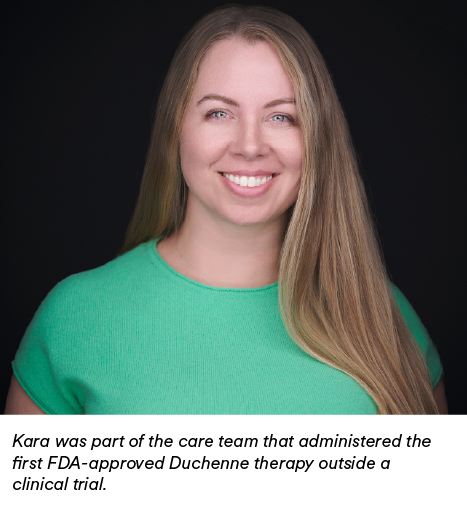
Kara Godwin, DNP, PNP
Pediatric neuromuscular nurse practitioner
Director, Medical Affairs, Sarepta
“The approval of the first treatment for Duchenne was an exciting and unforgettable time. I was a pediatric nurse practitioner working as a neuromuscular care coordinator at UF Health Shands Children’s Hospital at the time. Watching a treatment progress from clinical trial participation to becoming an option we could offer in clinic felt monumental, almost as if we were witnessing history unfold before our eyes.
Our team knew we would likely be the first to administer treatment commercially, and we were ready. In Duchenne, every minute represents muscle lost that may never be regained. I was determined not to let a single moment be wasted once treatment became available.
They taught me how to navigate conversations about risk and benefit in a space where there is no cure, but there are treatment options that aim to improve quality of life and alter the trajectory of disease.
So many moments from those years remain etched in my heart and mind. Through every interaction, one thing always stood out: the extraordinary resilience of patients and caregivers facing one of the most devastating diseases I have ever encountered. Duchenne affects far more than a person's ability to walk. It impacts every aspect of a patient's life and reaches every member of the family. Its progression is gradual but relentless, with each stage often bringing new challenges and difficult realities.
Those experiences strengthened my determination to translate scientific innovation into meaningful patient care. They taught me how to navigate conversations about risk and benefit in a space where there is no cure, but there are treatment options that aim to to improve quality of life and alter the trajectory of disease. They reinforced my commitment to do everything possible to advocate for what was best for each patient and family, recognizing that 'best' can look different for everyone.
The patients are still at the center of everything I do. They are who I think about every day, both those I continue to serve and those who remain in my memories. While my role has evolved, my purpose has not. I continue to advocate for the same goals, the same families, and the same hope for a better future, only now on a broader scale. Their resilience continues to inspire me, and their journeys remain the reason I do this work.”