

A closer look at how muscle MRI is helping healthcare providers and families understand Duchenne muscle changes over time.

In this Q&A, we speak with Kara Godwin, DNP, PNP, of Sarepta’s Medical Affairs team. Kara is a pediatric neuromuscular nurse practitioner with extensive experience caring for individuals of all ages living with Duchenne muscular dystrophy. She helped support early research using muscle MRI to study changes happening inside the muscles in Duchenne over time. In clinical care, she also used heart MRI to help identify early heart muscle changes before patients developed symptoms or before changes could be seen on routine heart testing like echocardiograms.
Here, she explains what muscle MRI is, what it has shown us about how Duchenne changes the muscles over time, and why this information is important for families to understand and discuss with their healthcare providers.
Q: What is muscle MRI and how is it used in Duchenne?
Kara: MRI, or magnetic resonance imaging, is a type of scan that lets doctors look inside the body. It can show signs of disease and disease progression even before symptoms are noticed.
In Duchenne, muscle MRI has mainly been used in research to help scientists and healthcare providers better understand how muscles change over time and to learn whether new treatments are working as intended.
Q: So, what has muscle MRI taught researchers about Duchenne?
Kara: Muscle MRI has helped scientists see what’s happening inside the muscles in much greater detail. It shows that in Duchenne, healthy muscle is replaced by fat and scar tissue over time; and that these changes can be happening inside the muscle even before weakness is obvious on the outside.
This has helped researchers understand that muscle damage starts very early and continues to build over time. Even when a child looks strong or appears stable, changes can still be happening inside the muscles. By the time difficulties with things like climbing stairs, running or walking show up, a significant amount of muscle has already been lost. And in Duchenne, once muscle is lost, it can’t be regained.
Q: And how is muscle MRI used to study new Duchenne treatments?
Kara: Muscle MRI helps researchers follow changes in the muscles over time. This makes it easier to understand Duchenne overall and to study what’s happening in the muscles when treatments are being researched. When studies show that fat and/or scar tissue is building up more slowly than expected, it may suggest the treatment is helping protect muscle by slowing disease-related muscle damage.
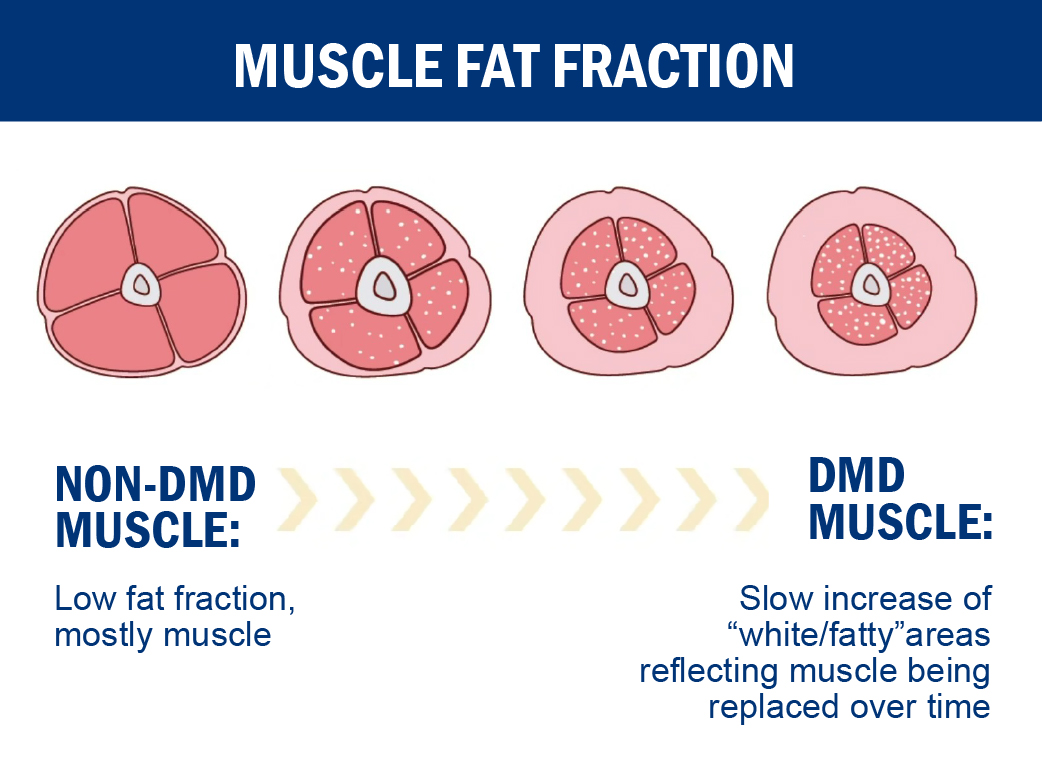 Q: What is fat fraction and why is it important in Duchenne?
Kara: Fat fraction is a way to measure how much muscle has been replaced by fat or scar tissue over time. A higher number means more muscle has been lost.
As Duchenne progresses, fat fraction usually goes up. Tracking these changes helps scientists understand how the disease affects muscles and whether new treatments may be helping slow the buildup of fat and scar tissue.
Q: What does all this research mean for Duchenne care today, and how can families use this information when talking with their care team?
Kara: The most important thing to know is that even when a child seems the same, changes can still be happening inside the muscles. Physical abilities in Duchenne may change gradually and can sometimes appear to stay the same for periods of time. However, changes within the muscle itself are often continuing underneath the surface. Knowing this can help families feel more prepared to ask questions and take an active role in conversations with their care team.
In Duchenne, time is muscle. That’s why many families find it important to talk early with their care team about care and treatment options that aim to slow muscle changes. These conversations can help families and providers plan ahead and make thoughtful decisions together about how best to support a child’s strength for as long as possible.
If you have questions about muscle MRI in Duchenne and how providers use muscle MRI data to evaluate Duchenne treatment options, talk to your healthcare provider or email our Patient Affairs team at [email protected].